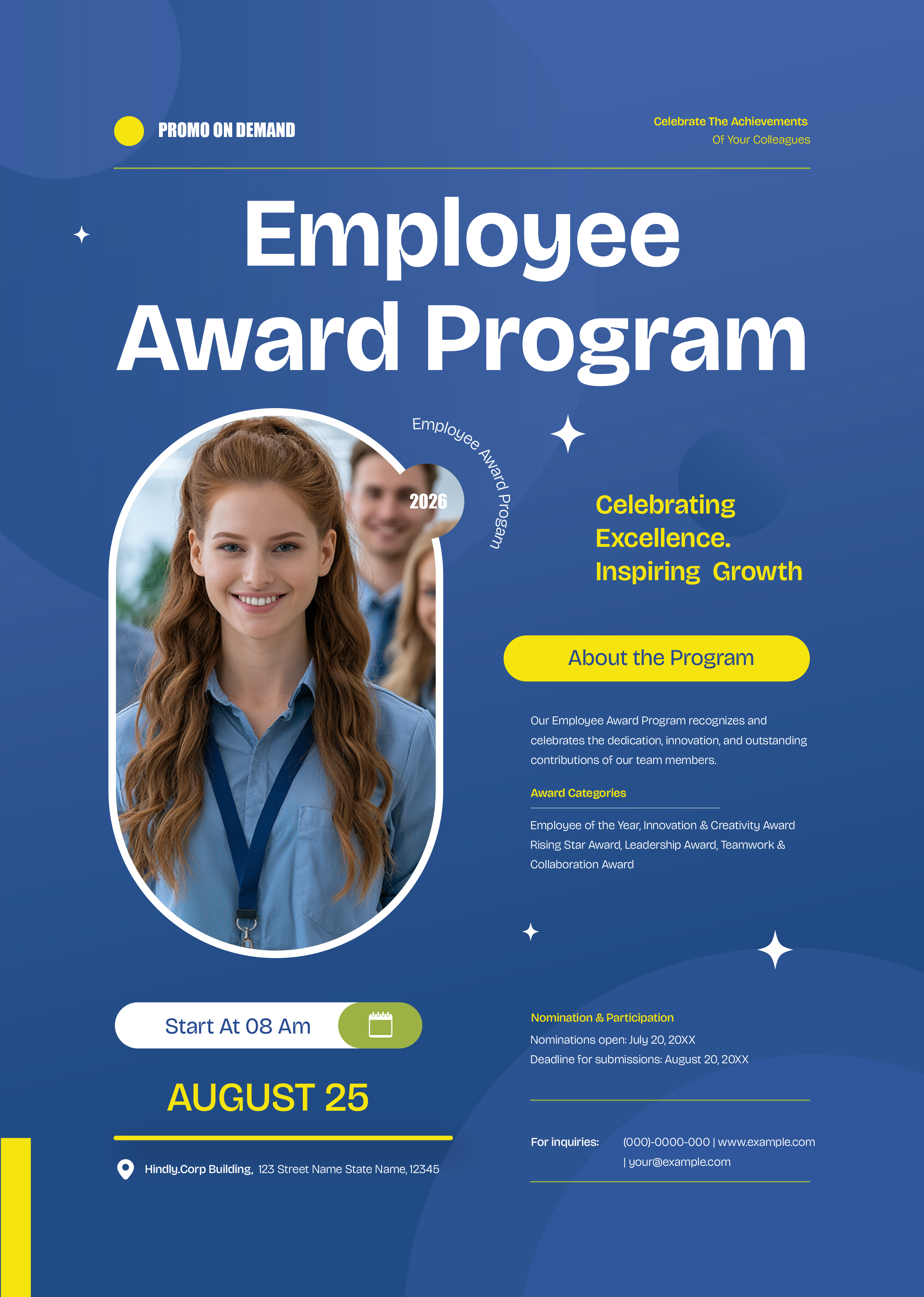
The single most underutilized driver of business performance isn't technology, marketing, or process optimization — it's the people already on your payroll. Employee recognition programs consistently rank among the top factors in staff retention, engagement, and productivity across every industry studied. And yet most businesses still rely on the same tired toolbox: a plaque on the wall, a gift card, a shoutout in the Monday meeting.
Promo on Demand's Campaign system gives you an entirely new dimension for employee recognition — one that's interactive, exciting, and scalable across any size organization. Instead of handing an employee a certificate, you hand them an experience. Instead of announcing a winner, you let them discover their reward through a live game play moment that the entire team can witness.
The psychology behind game-based recognition: Research consistently shows that variable rewards — outcomes where the prize is uncertain until the moment of revelation — generate stronger emotional responses and longer-lasting memories than fixed awards of equivalent value. A $50 gift card feels like $50. A spin of the wheel that reveals a $50 prize feels like winning.
Why Employee Recognition Drives Results
The business case for structured employee recognition is well-established. According to Gallup, organizations with highly engaged employees experience 21% higher profitability and 41% lower absenteeism compared to those with low engagement. Employee recognition is consistently identified as one of the top three drivers of engagement — alongside meaningful work and trust in leadership.
But recognition programs fail when they feel routine, impersonal, or arbitrary. The "Employee of the Month" poster works for the first few months, then becomes background noise. Annual awards ceremonies matter, but they're too infrequent to sustain day-to-day motivation. What actually moves the needle is consistent, timely, specific recognition — delivered close to the moment of the performance it celebrates.
Promo on Demand addresses this gap in multiple ways: campaigns can be launched instantly in response to a performance trigger, distributed via email or QR code with no printing or logistics required, and customized to feel specific to the achievement being celebrated. The technology does the heavy lifting. The recognition moment itself feels anything but automated.
The Game-Based Difference
Traditional recognition has a predictability problem. Everyone knows that the Employee of the Month gets a $25 gift card. The anticipation is gone; the reward feels transactional. Game-based recognition rebuilds the excitement of uncertainty without reducing the reliability of the recognition itself.
Here's the key insight: the game creates excitement regardless of the outcome. An employee who plays a wheel-spin and reveals "Free Lunch for Two" is more emotionally engaged in that moment than an employee who opens an envelope and finds a $20 gift card — even if the monetary value is similar. The difference is the experience of playing, anticipating, and discovering.
This effect is amplified when the game play is witnessed by colleagues. Public recognition — especially recognition delivered through an engaging, visible moment — carries social currency that private recognition cannot. When the team gathers around to watch a colleague spin the wheel at the shift briefing, the recognition reaches everyone in the room, not just the recipient.

How Internal Campaigns Work
Setting up an employee recognition campaign is structurally identical to setting up a customer-facing campaign — you use the same Campaign wizard, with the same options for game selection, prize configuration, and access control. The key difference is your audience: instead of external customers, you're distributing campaign links or QR codes to your own staff.
Here are the most effective distribution mechanisms for internal campaigns:
- Personalized campaign links via email: Send each qualifying employee a unique campaign link. Using one-to-one player mapping, you can ensure that each person receives a prize tier appropriate to their achievement level.
- Shared QR code at shift briefing: Display the campaign QR code at the start of a shift meeting. Qualifying employees scan and play right there in the room — creating a shared, visible recognition moment.
- Posted code in the break room: For ongoing performance campaigns (e.g., "play once per week if you had zero call-outs this week"), post the QR code in the break room and distribute the access window to eligible staff.
- Manager-distributed links: Empower supervisors to send campaign links directly to team members who have done something noteworthy — turning recognition into a manager tool, not just an HR function.
Triggering Recognition Events
The most effective employee recognition programs are tied to clear, specific triggers — behaviors or outcomes that you want to reinforce. Promo on Demand campaigns can be activated instantly, making it practical to recognize performance as close to the triggering event as possible.
Consider building campaigns around these trigger categories:
Service Excellence
- Receiving a positive comment card or online review
- Going above and beyond for a customer in a documented situation
- Perfect customer satisfaction scores for a month
- Resolving a service issue with exceptional skill and grace
Performance Milestones
- Hitting a sales target, upsell goal, or occupancy target
- Completing a full quarter with zero unexcused absences
- Training completion or certification achievement
- Work anniversary milestones (1 year, 3 years, 5 years)
Team & Competitive Goals
- Team-based challenges where a department earns campaign plays for hitting a collective target
- Friendly inter-department competitions (e.g., service floor vs. restaurant) where the winning team earns a campaign play session
- Safety milestones (days without incident)
- Efficiency achievements (average handle time, throughput, inventory accuracy)
Seasonal & Holiday Programs
- Holiday bonus campaigns that give all staff a chance to win additional perks
- End-of-year recognition campaigns that reward the entire team for a successful year
- Summer or summer sendoff campaigns to boost morale during traditionally slower periods

Multi-Industry Applications
Employee recognition campaigns work in any industry where people are the product. Here are specific ideas tailored to the industries where Promo on Demand customers operate:
Casino & Gaming
Casino employees — dealers, floor staff, hosts, cage workers — operate in a high-pressure environment where service quality directly affects table revenue and player satisfaction. Recognition programs here can target dealer excellence (measured by table atmosphere and tip averages), host relationship quality (measured by player retention and ADT), and floor efficiency (measured by average time to resolve service calls).
A particularly effective model for casino floors: a weekly "dealer of the week" campaign where the nominated dealer gets a campaign play during the pre-shift briefing in front of the full team. The prize pool includes shifts in preferred sections, additional days off, dining credits, or spa services — perks that feel meaningfully tied to the casino environment.
Hospitality & Hotels
In hotels and resorts, staff recognition often has to cross departments — housekeeping, front desk, F&B, concierge, and engineering all contribute to the guest experience but rarely share the same recognition framework. A unified Promo on Demand campaign gives department heads a single tool they can deploy for their own teams, while the overall program maintains consistency across the property.
Monthly recognition campaigns can be tied to property-wide guest satisfaction scores, with all staff sharing in the play pool when the property hits a target score. This creates cross-departmental alignment: everyone benefits when the guest experience is excellent, regardless of their individual role.
Retail
Retail environments naturally lend themselves to performance-based recognition — sales metrics are measurable, targets are clear, and the competitive instinct of sales staff can be channeled productively. Run weekly leaderboard campaigns where the top performers by units sold or upsell rate earn a game play. Configure prizes to include everything from cash bonuses to schedule preferences to exclusive product samples.
Retail recognition campaigns also work well for non-sales roles: stock room accuracy, receiving efficiency, shrinkage reduction, and visual merchandising excellence are all measurable and worth reinforcing through recognition.
Healthcare & Social Services
In healthcare settings — clinics, long-term care facilities, dental practices, veterinary offices — staff operate under significant emotional and physical demands. Recognition programs here should emphasize appreciation and team solidarity rather than pure performance metrics. Campaign plays tied to peer nominations ("nominate a colleague who went above and beyond this week") give the entire team a voice in recognition and create authentic, peer-driven moments of celebration.
Food Service & Restaurants
Restaurant staff turnover is notoriously high — recognition programs are one of the most effective tools for retention. Design campaigns around the moments that matter in a restaurant environment: a packed house handled flawlessly, a challenging service recovery executed with grace, a perfect health inspection score. Prizes tailored to hospitality culture resonate especially well: comped meals, reservations at sister properties, branded merchandise, or cash tips in the form of gift cards.
Reward Structures That Work
The prize structure for employee recognition campaigns should feel meaningful relative to the achievement it's celebrating. Here are the two primary approaches and when to use each:
Odds-Based Campaigns
All eligible employees have an equal chance of winning prizes from a configured pool. This works well for broad team recognition events — where a large number of employees participate and the goal is to create excitement and engagement across the group, not to differentiate between individuals. Configure a prize mix that includes several "good" prizes and one or two "great" prizes to maximize excitement.
One-to-One Prize Mapping
Each employee is guaranteed a specific prize tier based on their achievement level. A top performer receives a premium prize; a solid contributor receives a meaningful but less exceptional reward. This approach works best for structured performance tiers where you want to clearly signal that exceptional performance earns exceptional rewards. The game delivers the prize with theatrical flair, but the outcome is determined by your pre-configured mapping.
Fairness & Inclusivity
Employee recognition programs fail when they're perceived as unfair. A few principles that keep campaigns feeling inclusive and equitable:
- Make criteria transparent: Every employee should know exactly what they need to do to earn a campaign play. Arbitrary recognition breeds resentment; criteria-based recognition builds trust.
- Design for all roles: Ensure that every department and role type has a clear path to recognition — not just the most visible or customer-facing positions. Back-of-house, support staff, and administrative roles should have tailored criteria that reflect their actual contribution.
- Mix individual and team recognition: Balance programs that reward individual performance with campaigns that celebrate collective achievement. Over-indexing on individual competition can damage team cohesion.
- Acknowledge the effort, not just the outcome: Campaigns tied purely to results can feel demoralizing for employees whose outcomes depend on factors outside their control. Include campaigns that recognize behaviors and process quality, not just results.
Building a Recognition Culture
One-off recognition events have limited impact. What drives lasting change is a culture of recognition — an environment where acknowledging good work is habitual, expected, and valued. Promo on Demand campaigns contribute to that culture by making recognition visible, exciting, and repeatable.
To build toward a recognition culture:
- Run campaigns regularly — at least monthly — so recognition becomes an anticipated part of the work rhythm
- Involve managers in the process, empowering them to distribute campaign plays for in-the-moment recognition
- Share stories about recognition recipients in your internal communications — what they did, why it mattered, what they won
- Track and report on campaign participation and outcomes so leadership can see the engagement data
- Solicit peer nominations so recognition isn't exclusively top-down
Getting Started
Launching your first employee recognition campaign is quick. Here's a practical starting point:
- Identify the first performance behavior or milestone you want to celebrate
- Log into your Promo on Demand admin dashboard and create a new Campaign
- Configure your game and prizes — keep the prize pool tight and the rewards meaningful for your team
- Decide on your distribution method: personalized email links, a shared QR code, or manager-distributed access
- Announce the campaign to your team — transparency about what earns recognition and what the prizes are creates anticipation
- Run the first campaign, gather feedback, and refine for the next round
Questions about structuring an employee recognition program for your specific industry or team size? Contact our team — we've helped businesses design recognition programs that stick.